Showing posts with label Banned Books Week 2012. Show all posts

Saturday, October 6, 2012

Banned Books Week Quote: Beloved by Toni Morrison


Freeing yourself was one thing, claiming ownership of that freed self was another. 

History: Beloved, by Toni Morrison
  • Challenged at the St. Johns County Schools in St. Augustine, FL (1995). Retained on the Round Rock, TX Independent High School reading list (1996) after a challenge that the book was too violent.
  • Challenged by a member of the Madawaska, ME School Committee (1997) because of the book's language. The 1987 Pulitzer Prize winning novel has been required reading for the advanced placement English class for six years.
  • Challenged in the Sarasota County, FL schools (1998) because of sexual material.  Retained on the Northwest Suburban High School District 214 reading listing in Arlington Heights, IL (2006), along with eight other challenged titles.  A board member, elected amid promises to bring her Christian beliefs into all board decision-making, raised the controversy based on excerpts from the books she’d found on the Internet.  
  • Challenged in the Coeur d’Alene School District, ID (2007).  Some parents say the book, along with five others, should require parental permission for students to read them.
  •  Pulled from the senior Advanced Placement (AP) English class at Eastern High School in Louisville, KY (2007) because two parents complained that the Pulitzer Prize-winning novel about antebellum slavery depicted the inappropriate topics of bestiality, racism, and sex.  The principal ordered teachers to start over with The Scarlet Letter by Nathaniel Hawthorne in preparation for upcoming AP exams.

Friday, October 5, 2012

Banned Books Week Quote: The Call of the Wild by Jack London


He was mastered by the sheer surging of life, the tidal wave of being, the perfect joy of each separate muscle, joint, and sinew in that it was everything that was not death, that it was aglow and rampant, expressing itself in movement, flying exultantly under the stars. 

History: The Call of the Wild, by Jack London
  • Banned in Italy (1929), Yugoslavia (1929), and burned in Nazi bonfires (1933).
  • Generally hailed as Jack London’s best work, The Call of the Wild is commonly challenged for its dark tone and bloody violence. Because it is seen as a man-and-his-dog story, it is sometimes read by adolescents and subsequently challenged for age-inappropriateness. Not only have objections been raised here, the book was banned in Italy, Yugoslavia and burned in bonfires in Nazi Germany in the late 1920s and early 30s because it was considered “too radical.”

Thursday, October 4, 2012

Banned Books Week Quote: Gone with the Wind by Margaret Mitchell


Well, my dear, take heart. Some day, I will kiss you and you will like it. But not now, so I beg you not to be too impatient. 

History: Gone with the Wind, by Margaret Mitchell
  • Banned from Anaheim, CA Union High School District English classrooms (1978). 
  • Challenged in Waukegan, IL School District (1984) because the novel uses the word "nigger."

Wednesday, October 3, 2012

Banned Book Week Quote: To Kill A Mockingbird by Harper Lee


You never really understand a person until you consider things from his point of view... Until you climb inside of his skin and walk around in it.


History: To Kill a Mockingbird, Harper Lee, 1960

  • Challenged in Eden Valley, MN (1977) and temporarily banned due to words "damn" and "whore lady" used in the novel.
  • Challenged in the Vernon Verona Sherill, NY School District (1980)  as a "filthy, trashy novel."
  • Challenged at the Warren, IN Township schools (1981) because  the book does "psychological damage to the positive integration process" and "represents  institutionalized racism under the guise of good literature." After unsuccessfully trying to ban Lee's novel, three black parents resigned from the township human relations advisory  council.
  • Challenged in the Waukegan, IL School District (1984) because the novel uses the  word "nigger."
  • Challenged in the Kansas City, MO junior high schools (1985). Challenged at  the Park Hill, MO Junior High School (1985) because the novel "contains profanity and  racial slurs." Retained on a supplemental eighth grade reading list in the Casa Grande, AZ  Elementary School District (1985), despite the protests by black parents and the National  Association for the Advancement of Colored People who charged the book was unfit for junior high use.
  • Challenged at the Santa Cruz, CA Schools (1995) because of its racial themes.  Removed from the Southwood High School Library in Caddo Parish, LA (1995) because the book's language and content were objectionable.
  • Challenged at the Moss Point, MS School District (1996) because the novel contains a racial epithet. Banned from the Lindale, TX advanced placement English reading list (1996) because the book "conflicted with the values of the community."
  • Challenged by a Glynn County, GA (2001) School Board member because of profanity. The novel was retained. Returned to the freshman reading list at Muskogee, OK High School (2001) despite complaints over the years from black students and parents about racial slurs in the text.
  • Challenged in the Normal, IL Community High School's sophomore literature class (2003) as being degrading to African Americans.
  • Challenged at the Stanford Middle School in Durham, NC (2004) because the 1961 Pulitzer Prize-winning novel uses the word "nigger."  
  • Challenged at the Brentwood, TN Middle School (2006) because the book contains “profanity” and “contains adult themes such as sexual intercourse, rape, and incest.”  The complainants also contend that the book’s use of racial slurs promotes “racial hatred, racial division, racial separation, and promotes white supremacy.”  
  • Retained in the English curriculum by the Cherry Hill, NJ Board of Education (2007).  A resident had objected to the novel’s depiction of how blacks are treated by members of a racist white community in an Alabama town during the Depression.  The resident feared the book would upset black children reading it.  
  • Removed (2009) from the St. Edmund Campion Secondary School classrooms in Brampton Ontario, Canada because a parent objected to language used in the novel, including the word “nigger."

Tuesday, October 2, 2012

Banned Books Week Quote: A Streetcar Named Desire by Tennessee Williams


What is straight? A line can be straight, or a street, but the human heart, oh, no, it's curved like a road through mountains.


History: A Streetcar Named Desire, Tennessee Williams, 1947

  • The sexual content of this play, which later became a popular and critically acclaimed film, raised eyebrows and led to self-censorship when the film was being made. The director left a number of scenes on the cutting room floor to get an adequate rating and protect against complaints of the play’s immorality.


Monday, October 1, 2012

Banned Books Week Quote: Their Eyes Were Watching God by Zora Neale Hurston


If you kin see de light at daybreak, you don't keer if you die at dusk. It's so many people never seen de light at all.

History: Their Eyes Were Watching God, by Zora Neale Hurston 
  • Challenged for sexual explicitness, but retained on the Stonewall Jackson High School's academically advanced reading list in Brentsville, VA (1997). A parent objected to the novel's language and sexual explicitness.

Sunday, September 30, 2012

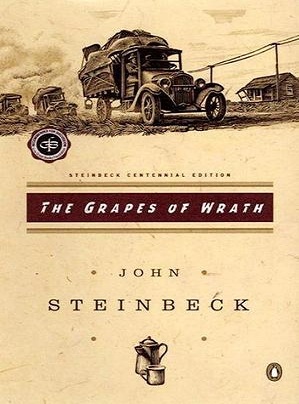
Banned Books Week Quote: The Grapes of Wrath by John Steinbeck


And the little screaming fact that sounds through all history: repression works only to strengthen and knit the repressed.
History: The Grapes of Wrath, by John Steinbeck

  • Burned by the East St. Louis, IL Public Library (1939) and barred from the Buffalo, NY Public Library (1939) on the grounds that "vulgar words" were used. Banned in Kansas City,  MO (1939).
  • Banned in Kern County CA, the scene of Steinbeck's novel (1939).
  • Banned in  Ireland (1953).
  • On Feb. 21, 1973, eleven Turkish book publishers went on trial before an  Istanbul martial law tribunal on charges of publishing, possessing and selling books in  violation of an order of the Istanbul martial law command. They faced possible sentences of  between one month's and six months' imprisonment "for spreading propaganda unfavorable to  the state" and the confiscation of their books. Eight booksellers were also on trial with  the publishers on the same charge involving The Grapes of Wrath.
  • Banned in Kanawha, IA High  School classes (1980).
  • Challenged in Vernon Verona Sherill, NY School District (1980). 
  • Challenged as required reading for Richford, VT (1981) High School English students due to  the book's language and portrayal of a former minister who recounts how he took advantage  of a young woman.
  • Banned in Morris, Manitoba, Canada (1982).
  • Removed from two Anniston,  Ala. high school libraries (1982), but later reinstated on a restrictive basis.
  • Challenged  at the Cummings High School in Burlington, NC (1986) as an optional reading assignment  because the "book is full of filth. My son is being raised in a Christian home and this book takes the Lord's name in vain and has all kinds of profanity in it." Although the  parent spoke to the press, a formal complaint with the school demanding the book's removal  was not filed.
  • Challenged at the Moore County school system in Carthage, NC (1986) because  the book contains the phase "God damn."
  • Challenged in the Greenville, SC schools (1991)  because the book uses the name of God and Jesus in a "vain and profane manner along with  inappropriate sexual references."
  • Challenged in the Union City, TN High School  classes (1993).


Related Posts Plugin for WordPress, Blogger...